It's 9:40 on a Tuesday night. Somebody's car just made a noise it has never made before, or it's sitting on a shoulder with the hazards on. They find you, tap your number, and get your after-hours message.
That message is short. But it's packed with promises.
"Someone will call you right back." "We're here for you 24/7." "Press 2 for towing." Every one of those lines is a small IOU to a stranger at the moment they're most stressed. And most shops recorded theirs years ago, on a quiet afternoon, and haven't heard it since.
So here's an exercise for one evening this week. You'll call your own line, write down what it promises, and then do the part almost nobody does: wait and see which promises actually come true.
Why bother? Because the message isn't the only thing talking
Your voicemail greeting is just one of the places your business makes promises after closing time. Customers might also see:
- Your Google Business Profile hours. Google asks businesses to list their regular customer-facing hours, and to use special hours for holidays and other one-off days (Google Business Profile guidelines; How to set special hours).
- Your Google Ads call button. Google Ads lets you schedule call assets so your number shows only when your business can take calls. Google's own advice is blunt: don't generate a call you can't accept (About call assets; Set up your call ads for success).
- Your website. "24/7" in a header. "Call anytime" on the contact page. A form that says "we'll reply shortly."
- Your missed-call text or form auto-reply, if you have one.
If those places disagree, the customer doesn't know which one to believe. If the message promises something nobody actually does, the customer learns that, too.
Timing note: Thanksgiving is Thursday, November 26. Google says a notice may appear on your profile around certain holidays saying your hours might differ, and suggests setting special hours ahead of time (About holidays on Google). This audit is a good excuse to check those before the holiday, not after.
The test: call yourself after closing
You'll need: a phone that isn't saved as "Boss" in your shop's system, the worksheet at the bottom of this article, and about 15 minutes tonight plus a quick check tomorrow.
Rules:
- Don't warn anyone. The point is to hear what a customer hears and see what a customer gets.
- Call at a realistic time. Pick when real after-hours calls come in. Right after closing, mid-evening, or late at night are three different tests.
- Write the message down word for word. Not a summary. The exact words. (Easiest way: call twice.)
- Go down every path. If it says "press 2 for towing," press 2. If it says "text us," text.
- Leave a message like a customer would, with your own cell number and one odd, made-up detail (say, "my car is the one with the pineapple air freshener") so you'll recognize it when it comes back to you.
- Then just wait. Note what happens, and when.
Ask the same of any answering service or call-handling team you use. They're part of the promise too.
Sort every sentence into four buckets
Go through your transcript line by line and label each sentence:
- Promise: something your business will do. ("Someone will call you back.") Promises need an owner and a clock.
- Instruction: something the caller should do. ("Leave your name and vehicle." "If you're in danger, call 911.")
- Fact: something that's simply true or not. ("We open at 8.")
- Fog: words that sound like a promise but can't be checked. ("As soon as possible." "We'll take care of you.")
Fog is the sneaky one. "As soon as possible" at 9:40 p.m. can sound like in a few minutes to the caller and mean sometime tomorrow to you. Nobody is lying. But somebody is going to be disappointed.
A fictional example
Here's a made-up after-hours greeting for an imaginary shop. It isn't from any real business, but it's built from lines most of us have heard:
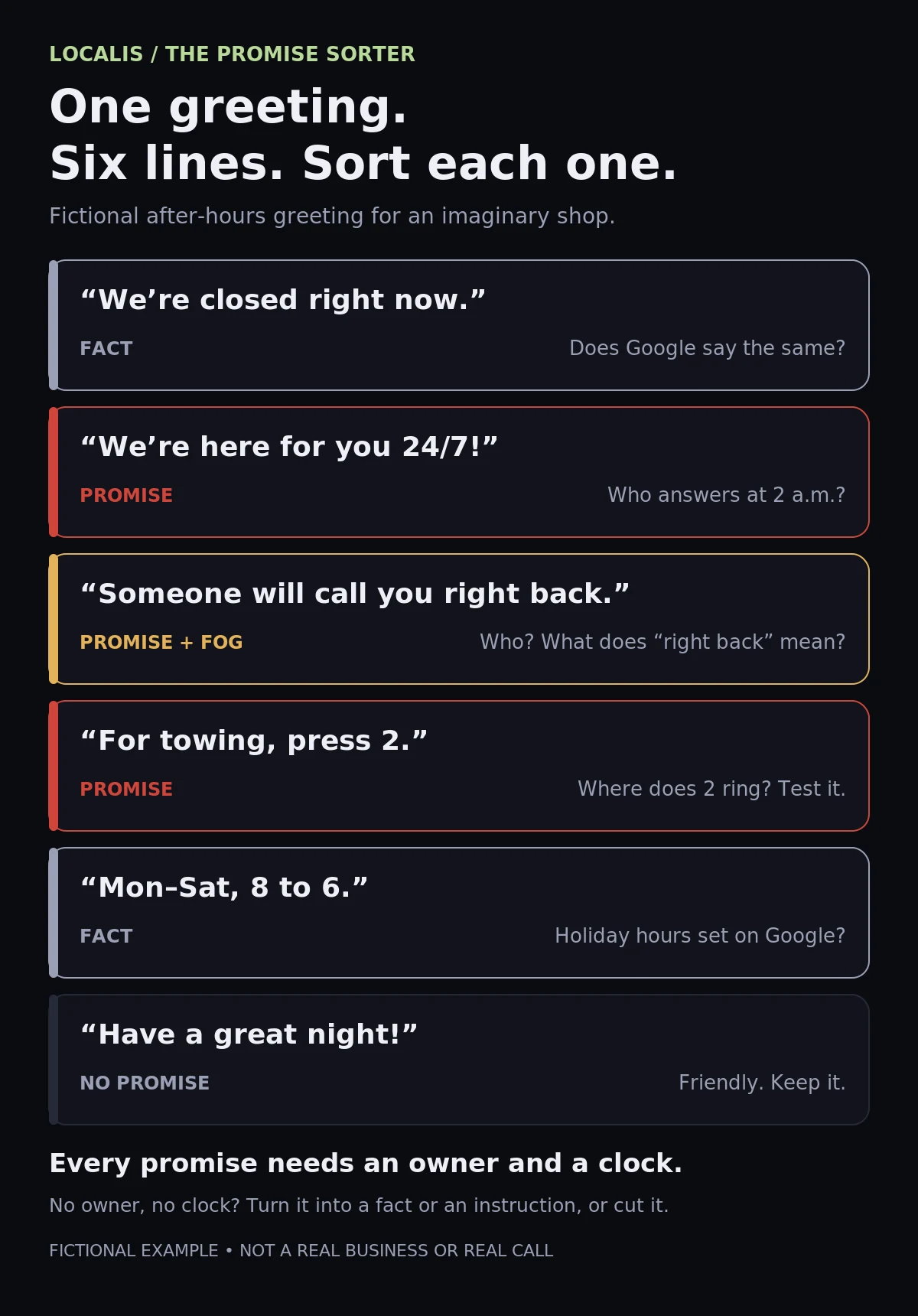
(Fictional example) "Thanks for calling [Shop name]. We're closed right now, but we're here for you 24/7! Leave your name and number and someone will call you right back. For towing, press 2. Our hours are Monday through Saturday, 8 to 6. Have a great night!"
Sorted:
| Exact words | Bucket | Question to check |
|---|---|---|
| "We're closed right now" | Fact | Does it match the hours on Google and your website? |
| "We're here for you 24/7" | Promise | Here how? Who answers at 2 a.m.? It also contradicts the line before it. |
| "Someone will call you right back" | Promise + fog | Who is "someone"? What does "right back" mean at night? |
| "For towing, press 2" | Promise | Where does 2 actually ring? Did a person pick up? |
| "Monday through Saturday, 8 to 6" | Fact | Same as Google? Holiday hours set? |
| "Have a great night!" | Nothing | Friendly. Keep it. |
Now the part that matters. In our imaginary test, pressing 2 rings a phone in an empty office, and the "right back" callback happens the next morning at 10:15. Two promises, both broken, and neither one because anybody was lazy. The message just promised more than the after-hours setup could keep.
Rewrite: only promise what tomorrow-morning you will do
The fix isn't a longer message. It's a more honest one. For every promise, you should be able to name who keeps it and by when. If you can't, turn it into an instruction or a fact, or cut it.
Here's the same fictional shop, rewritten:
(Fictional example) "You've reached [Shop name]. The office is closed until 8 tomorrow morning. If you're somewhere unsafe, hang up and call 911. Leave your name, number and vehicle, and we'll return overnight messages by 9:30 a.m. If you need a tow tonight, we're not able to send one after hours, so please call another tow service."
Is that last line less exciting than "24/7"? Sure. It's also true, and a stranded driver will thank you for not making them wait on a callback that won't come until morning.
If you do run a real overnight tow line, say so and make sure it works: the exact route, who carries the phone, and what happens if they're already on a call. And then test that path too.
One more check: whatever window you promise ("by 9:30 a.m."), someone has to own it at 8:00 a.m. That's where this audit connects to our handoff drill: an overnight message is a handoff from the night to the morning crew.
Line it up with everywhere else
Last step. With your rewritten message in hand, check that the other places customers look tell the same story:
- Google Business Profile: regular hours match, special hours are set for upcoming holidays, and anything like separate towing hours is accurate. Google offers "More hours" for services with different times, generally as a subset of your main hours (Edit your business hours; guidelines).
- Google Ads: if you run call ads or call assets, the schedule matches when someone can really answer.
- Website: no "24/7" unless it's true. Your hours are written as page text, not just in an image.
- Auto-texts and form replies: same promise, same window.
The worksheet
Copy this into a notes app, a doc, or a sheet of paper by the phone:
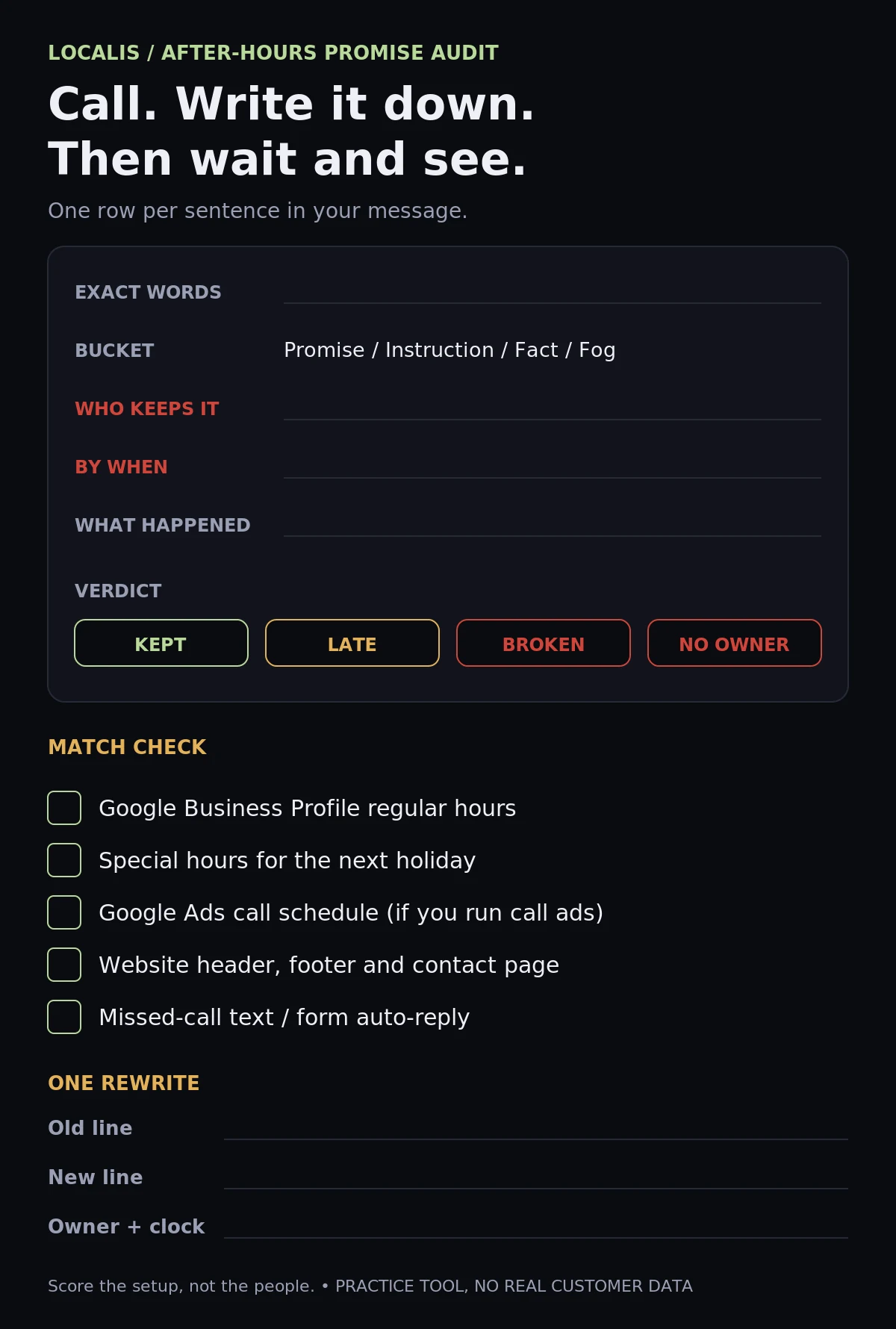
AFTER-HOURS PROMISE AUDIT

Date / time I called: ____________   Number I called: ____________
Path(s) I tried:  [ ] Main greeting  [ ] Menu options  [ ] Text  [ ] Answering service

FOR EACH SENTENCE IN THE MESSAGE:
Exact words:        ______________________________________________
Bucket:             Promise / Instruction / Fact / Fog
If a promise:
  Who keeps it:     ______________________
  By when:          ______________________
What actually happened (and when): ______________________________
Verdict:            Kept / Kept late / Broken / Nobody owns it

MATCH CHECK (does each say the same thing as the message?)
[ ] Google Business Profile regular hours
[ ] Special hours set for the next holiday
[ ] Google Ads call schedule (if you run call ads)
[ ] Website header, footer, contact page
[ ] Missed-call text / form auto-reply

ONE REWRITE:
Old line: _______________________________________________________
New line: _______________________________________________________
Owner + clock for the new line: ___________________________________

Retest date: ____________
Score the setup, not the people. If a promise was broken, the question is "what would have to be true for this to be kept?", not "who dropped it?"
Run it again after any change
New phone system, new answering service, new hours, a holiday coming up, a new driver on call: re-run the test. It takes one evening, and it's the only way to hear your business the way your after-hours customers do.
Where Localis fits
Localis builds websites, runs Google Ads, handles SEO, and offers US-based call handling and support for local shops, including towing and auto repair. That means we spend a lot of time on exactly this seam: what your listings, ads and phone line say, and what actually happens after someone calls.
If you'd like a second set of eyes on your after-hours setup, get in touch. Bring your filled-in worksheet. We'll help you sort the promises from the fog.
The voicemail greetings, test result and shop in this article are fictional examples written for illustration. They aren't real businesses, real customers, or real Localis calls.