The phone rings. You answer, you help, you hang up, and you scribble something down.
"Mike – Silverado – call back."
Ten minutes later you're under a car, out on a tow, or gone for the day. Somebody else picks up the note.
Which Mike? Call back about what? Did you already promise him something?
Most phone advice is about the call itself: how to answer, what to ask, how to sound friendly. This one is about what happens after you hang up. Because the call isn't finished when the line goes quiet. It's finished when the next right thing actually happens, and very often that next thing is done by someone else.
So here's a test. It takes about 20 minutes, two people, and no software.
Why borrow this from hospitals?
Hospitals hand patients from one shift to the next every day, and they've studied what goes wrong in that moment. One structured handoff method, called I-PASS, is now promoted by the federal Agency for Healthcare Research and Quality as an evidence-based way to do it (AHRQ: I-PASS tool).
When nine hospitals rolled out an I-PASS training program, the study published in the New England Journal of Medicine reported fewer medical errors afterward, and the spoken handoffs didn't take noticeably longer (NEJM, 2014).
Your shop isn't a hospital, and we're not promising you hospital results. But two ideas from I-PASS travel well:
- Write the action list with an owner and a deadline, not just "call back."
- Have the receiver say the plan back in their own words. I-PASS calls this "synthesis by receiver." It's the step most of us skip.
That second idea is the whole drill.
The drill: two coworkers, three fake calls
You'll need: two people (the Caller-Taker and the Next Person), the same notepad, message pad, or system you really use, and the three scripts below. Do it on a slow afternoon, not during a rush.
Rules:
- The Caller-Taker reads the script aloud like a phone call and writes their usual note. Not a "perfect" note. Their normal one.
- The Next Person doesn't hear the call. They step outside, or put on headphones.
- The Next Person gets only the written note and has to answer three questions out loud:
- What exactly should happen next, and who does it by when?
- What did we already promise this customer?
- What don't we know yet?
- No asking the Caller-Taker for help. That's the point. In real life, they're on a tow.
Then compare the answers to the script. Every gap is a free lesson.
Fictional call 1: the new request
"Hi, my daughter's car died in the parking lot at the community college. It's a 2012 Civic. She's okay, she's inside the library. Can somebody tow it to you and look at it? My number's on caller ID but she has the keys, and she's got class until 3."
What a weak note looks like: "Civic – tow – college."
What the Next Person needs to know: who's paying and who has the keys (two different people), where the car actually is, the time window (class until 3), whether the shop said yes to the tow and yes to the inspection, and what wasn't confirmed yet: no price quoted, no diagnosis, no promised pickup time.
Fictional call 2: the update on an existing job
"Hey, it's Dana, I dropped off the gray Camry Tuesday. The guy said he'd call me with the estimate yesterday and nobody did. I need to know today because I have to decide about a rental."
What a weak note looks like: "Dana called re Camry."
What the Next Person needs to know: that a callback was promised and missed (so this one is now a bit hot), that her deadline is today because of a rental decision, and which job record it ties to. A good note also says what the person who answered told her: "I said someone would call by 2" is a new promise the next person now owns.
Fictional call 3: the after-hours callback
(Voicemail, 9:40 p.m.) "Yeah, I'm calling about the bumper. You guys looked at it last week? I'm just wondering if the insurance thing came through. Call me back tomorrow, I'm off after noon."
What a weak note looks like: "Bumper guy – insurance?"
What the Next Person needs to know: that no name was left (so the note should say "name not given" rather than leaving it blank), the callback number, the best window (after noon), and the honest status: nobody has checked on the insurance yet. The note shouldn't guess that "it's probably approved."
Score it in one minute
For each call, mark the Next Person's three answers:
- Got it: they named the right next step, owner, and deadline.
- Guessed: they landed close, but only by assuming.
- Stuck: they'd have to call the customer back and start over.
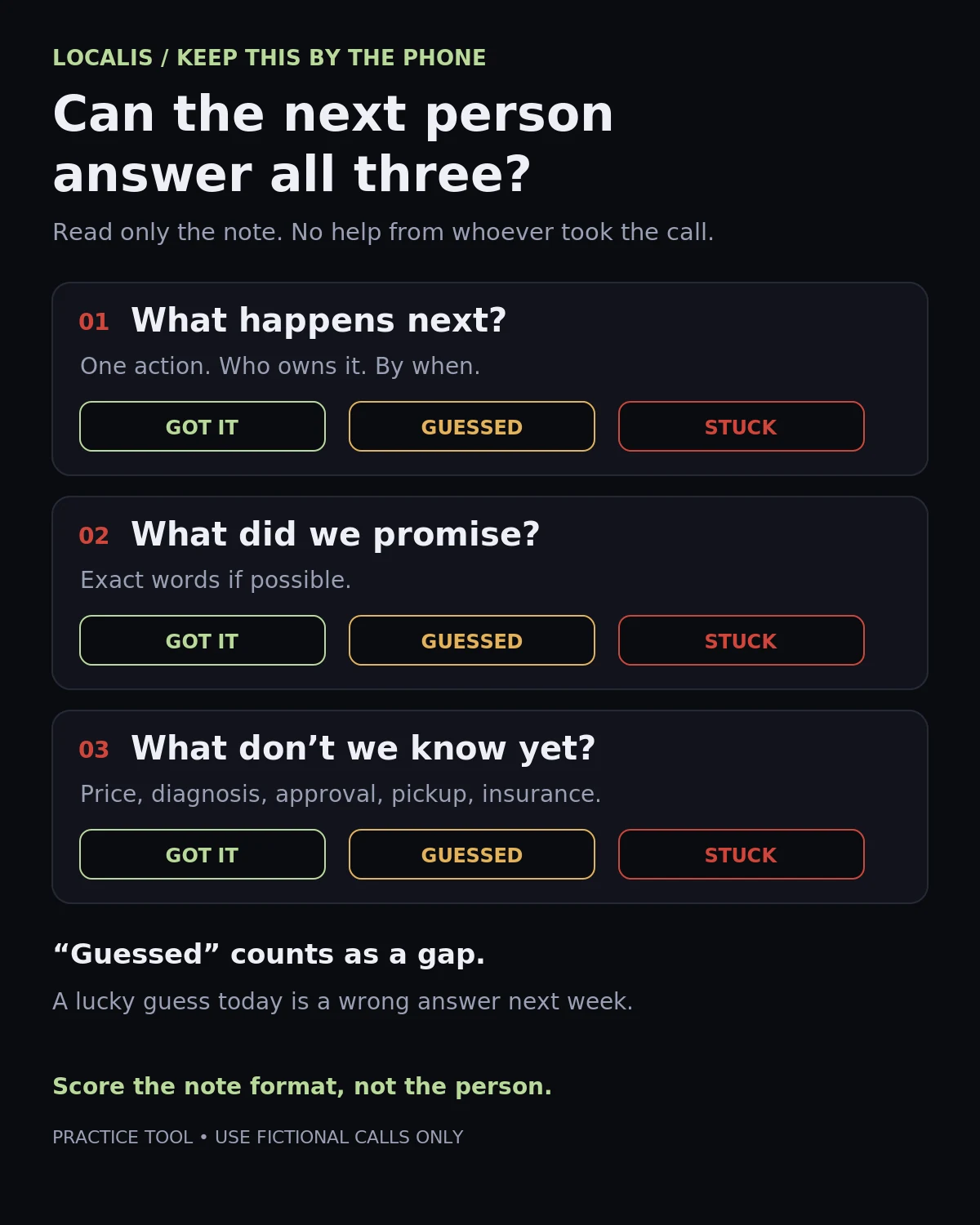
"Guessed" is the sneaky one. A guess that happens to be right today is a wrong answer next week.
Don't turn the scores into a report card for staff. The note format is what's being tested, not the person holding the pen.
The fix: a handoff card, not another intake form
Most shops already have an intake checklist: name, number, vehicle, problem. That list is about collecting information. A handoff card is about passing on the job. It's built around the three questions the Next Person had to answer.
Copy this and keep it by the phone, in your message pad, or as a note template in whatever system you use:
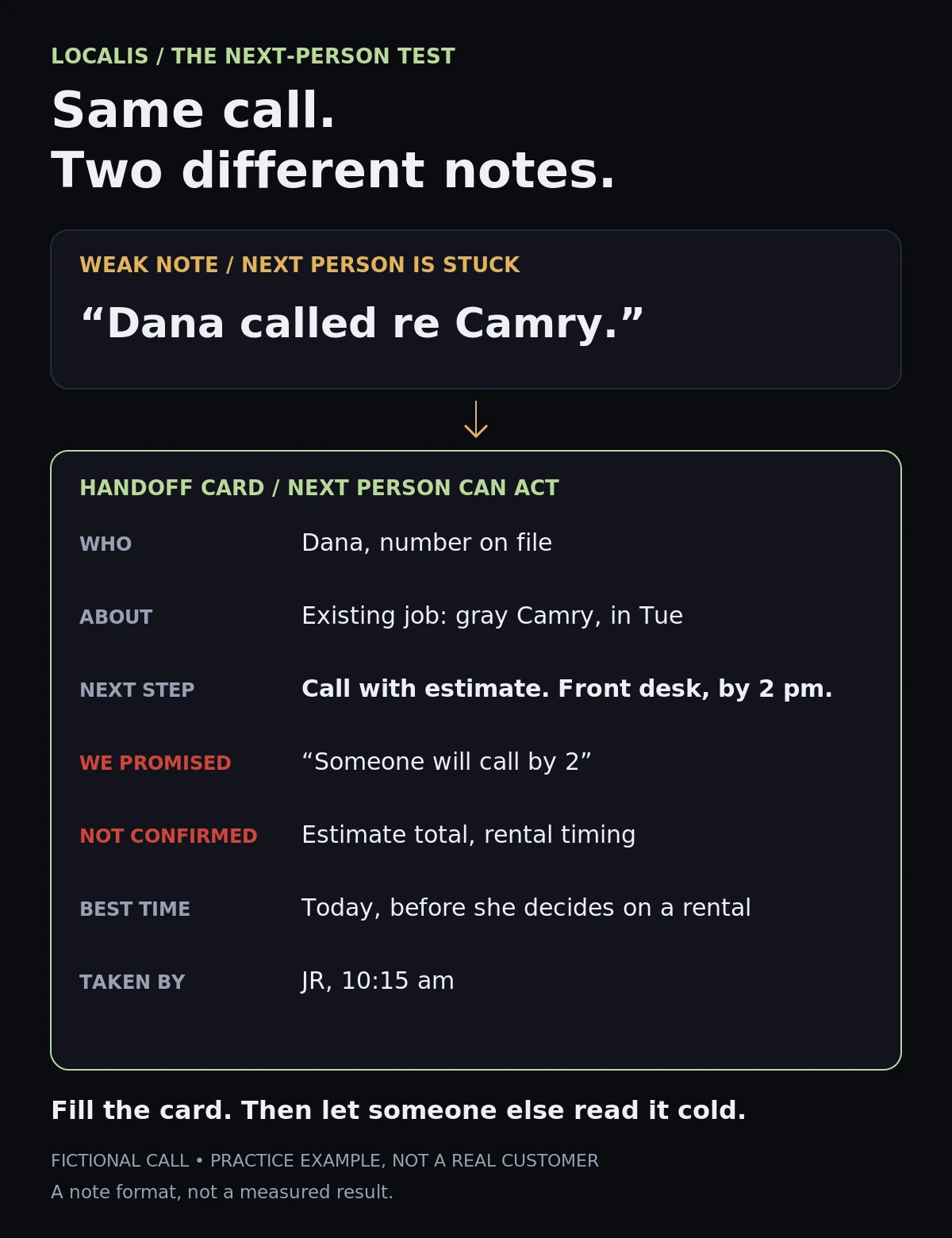
HANDOFF CARD
Who:            Name (or "not given") + best number
About:          New request / existing job (which one?) / other
Next step:      One action. Who owns it. By when.
We promised:    Exact words if possible ("someone will call by 2")
Not confirmed:  Price? Diagnosis? Approval? Pickup time? Insurance?
Best time:      When they can actually talk or meet
Taken by:       Initials + time
Two lines do most of the work:
- "We promised" stops the classic mess where a customer heard "by 2" and nobody else knew.
- "Not confirmed" protects you. Writing "no price given" is just as useful as writing a price.
Run it again in a week
Swap roles and use three new fictional calls. Write your own based on the calls you actually get, just keep them made-up: no real customer names, numbers, or job details in the practice scripts.
When the Next Person can answer all three questions from the card alone, you've built something useful: a front desk that doesn't depend on one person's memory.
Where Localis fits
Localis builds websites, runs Google Ads, and handles SEO for local shops. We also offer US-based call handling and support. Whoever answers your phone, the drill works the same way: the call is only as good as the note it leaves behind.
If you'd like a second set of eyes on how calls move through your business, get in touch. Bring your handoff card. We'll bring questions.
All calls, names and vehicles in this article are fictional examples written for practice. They aren't real customers or real Localis calls.